PLANETARY SCIENCES
Second Edition (July 2010)
Second Revised Edition (January 2015)
Imke de Pater and Jack J. Lissauer
[Cambridge: ISBN-13: 9780521853712 Hardback £50.00 / $80.00]
PLANETARY SCIENCES
Second Edition (July 2010)
Second Revised Edition (January 2015)
Imke de Pater and Jack J. Lissauer
[Cambridge: ISBN-13: 9780521853712 Hardback £50.00 / $80.00]
The space age with lunar missions and interplanetary probes, has revolutionized our understanding of the Solar System. Planets and large moons, which previously appeared in telescopes only as fuzzy disks, have become familiar worlds, with a range of diverse properties. Large numbers of asteroids, comets and small moons have now been discovered, and many of these objects studied in detail. The number of planets now known to orbit stars other than our Sun far exceeds those within our own Solar System. As a result, our understanding of the process of star and planet formation is increasing all the time.
Planetary Sciences presents a comprehensive coverage of this fascinating and expanding field at a level appropriate for graduate students and juniors and seniors majoring the the physical sciences. The second edition of this awarding-winning textbook explains the wide variety of physical, chemical, and geological processes that govern the motions and properties of planets. The new Edition contains a reorganized discussion of small bodies, including a detailed description of the Kuiper belt and asteroid belt; a significantly expanded chapter on extrasolar planets and what they tell us about planetary systems; and appendixes providing a glossary of acronyms, tables of key spacecraft, a summary of observing techniques, and a sampling of very recent images. With over 300 exercises to help students apply the concepts covered, this textbook is ideal for courses in astronomy, planetary science and earth science, and well suited as a reference for researchers. Color versions of many figures and movie clips supplementing the text are available at www.cambridge.org/9780521853712.
Chambliss Astronomical Writing
Award:
Planetary Sciences received the Chambliss Astronomical Writing
Award for 2007. This is an award given by the American Astronomical
Society (AAS) for astronomy books for an academic audience,
specifically textbooks at either the upper division undergraduate
level or the graduate level.
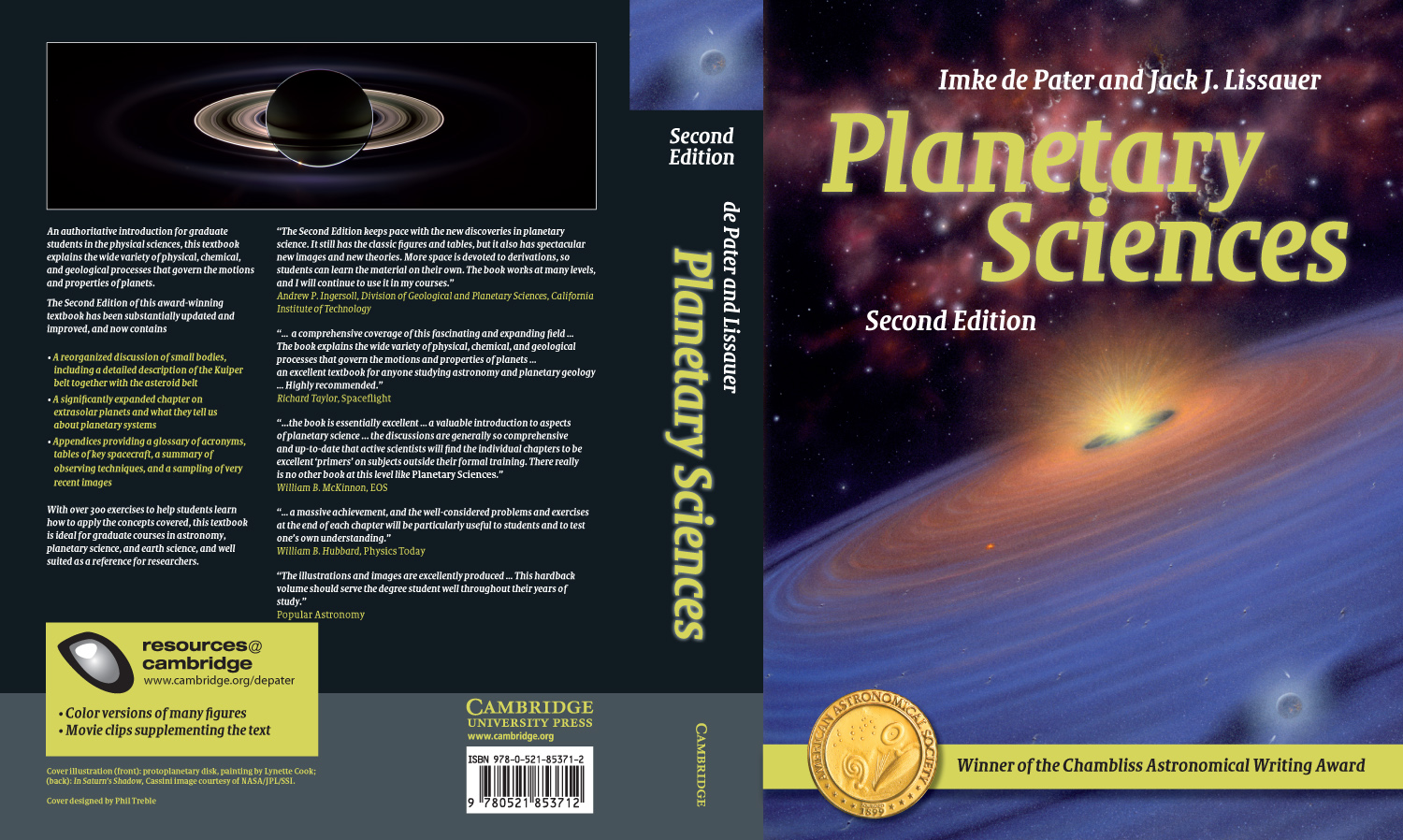
FRONT COVER:
Artists' conception of a protoplanetary disk. A growing giant planet
appears in the foreground (lower right). This planet has a massive
atmosphere, and it has partially cleared a gap around its orbit
via gravitational torques (see Chapters 11 and 13). It is accreting
both gas and small planetesimals; the latter shed material as they
fall into the planet's atmosphere and look like comets. Numerous
lunar-sized planetary embryos within the disk are visible through
the gravitational wakes that they create in the disk of small planetesimals;
such wakes have been observed in Saturn's rings. A pair
of these bodies has just collided and glows red. The star at the
center of the disk is in its final stages of accretion, and is expelling
gas through a bipolar wind. The disk near the star is warmed by
both starlight and viscous dissipation within the disk itself; both
processes provide more energy closer to the center of the disk. The
blue shading of the outer disk is intended to give the impression of
cool temperatures, but in reality such regions would appear dark
red; similarly, the radially symmetric structure in the disk has been
exaggerated in order to convey the impression of rotation. The top
of the painting shows other young stars and interstellar gas and
dust that inhabit the same stellar nursery as the star/disk system
seen close-up. Painted by Lynette Cook (www.lynettecook.com)
in 1999, with scientific consultation of Jack Lissauer.
BACK COVER:
Panoramic view of Saturn, created by combining 165 images taken
by the wide-angle camera on the Cassini spacecraft in September
2006. The mosaic images were acquired while the spacecraft was in
Saturn's shadow, and hence the rings are seen in forward scattered
light. Such a viewing geometry enhances light from microscopic
grains. The Gring is easily seen here, outside the bright main rings,
while the extended E ring encircles the entire system. Enceladus
appears as a white dot within the E ring in the lower left portion of
the figure, and Earth is the pale blue dot just inside the G ring in
the upper left. (Based on PIA08329, NASA/JPL/SSI/M. Hedman,
M. Fondeur and F. van Breugel).
Contents:
Preface; 1. Introduction; 2. Dynamics; 3. Solar heating and energy transport; 4. Planetary atmospheres; 5. Planetary surfaces; 6. Planetary interiors; 7. Magnetic fields and plasmas; 8. Meteorites; 9. Minor planets; 10. Comets; 11. Planetary rings; 12. Extrasolar planets; 13. Planet formation; Appendices; References; Index.
>>Detailed Table
of Contents<<
>>University of Cambridge Press<<
Reviews
Andrew P. Ingersoll, Division
of Geological and Planetary Science, California Institute of Technology :
'I am really impressed ... The book covers the important physical processes in all areas of planetary science. My favorite derivations are all there, along with the important figures, graphs, and tables that show the data. The numerous homework problems challenge the student to understand the equations and think independently. The book sets the standard for what we should be teaching those who want to become professionals in this field. I will recommend it to all my students and look forward to using it in my courses.'
William B. McKinnon, EOS:
' ... the book is essentially excellent. Given their formidable task, de Pater and Lissauer have done as good a job as can be imagined, and I can't imagine two other authors doing a better job on a first edition ... this book could serve as a valuable introduction to aspects of planetary science that graduate students might never study at all ... the discussions are generally so comprehensive and up-to-date that active scientists will find the individual chapters to be excellent 'primers' on subjects outside their formal training. There really is no other book at this level like Planetary Sciences.'
William B. Hubbard, Physics Today:
'... a massive achievement, and the well-considered problems and exercises at the end of each chapter will be particularly useful to students and to test one's own understanding.'
Richard Taylor,
Spaceflight:
'Planetary Sciences presents a comprehensive coverage of this fascinating and expanding field at a level ... The book explains the wide variety of physical, chemical and geological processes that govern the motions and properties of planets ... a very useful book ... an excellent textbook for anyone studying astronomy and planetary geology ... a rich source of knowledge ... Highly recommended.'
Lunar and Planetary Information Bulletin:
'... a comprehensive overview of the planetary science field ...'