Welcome
I am a faculty member in the Astronomy Department at the University of California, Berkeley, and affiliated with the SETI Institute in Mountain View, California, and a visiting scientist at the Institute of Astrophysics in Heraklion, Crete. You might also like some of the videos I created for my YouTube Channel. If you arrived here searching for my open water swimming guidebook, please go to the Crete Swim web site, or if you’re interested in my guidebook for dreams, go to The Oneironauts web site.
My expertise is searching for planetary systems around nearby stars using direct imaging. My methods involve data from the world’s most advanced observatories, such as the Hubble Space Telescope, Keck Observatory, the Gemini Telescopes, and ALMA.
One remarkable image is the planetary system surrounding Fomalhaut (see below), which is a bright star located 25 light years away in the constellation Pisces Australis. Though direct images are difficult to obtain and currently quite rare, they provide unique and fundamental information about exoplanetary systems, such as:
- The masses of exoplanets, by analyzing how bright they appear and the properties of their orbits.
- Their composition, by analyzing the color of thermal emission from the planet, or by obtaining a spectrum.
- The origin of exoplanets, by comparing their current observed properties with simulations of how planets form in a circumstellar disk and subsequently evolve.
Ultimately, these data will give us an empirical notion of how common or rare our own planetary system must be in our own galaxy and throughout the universe.
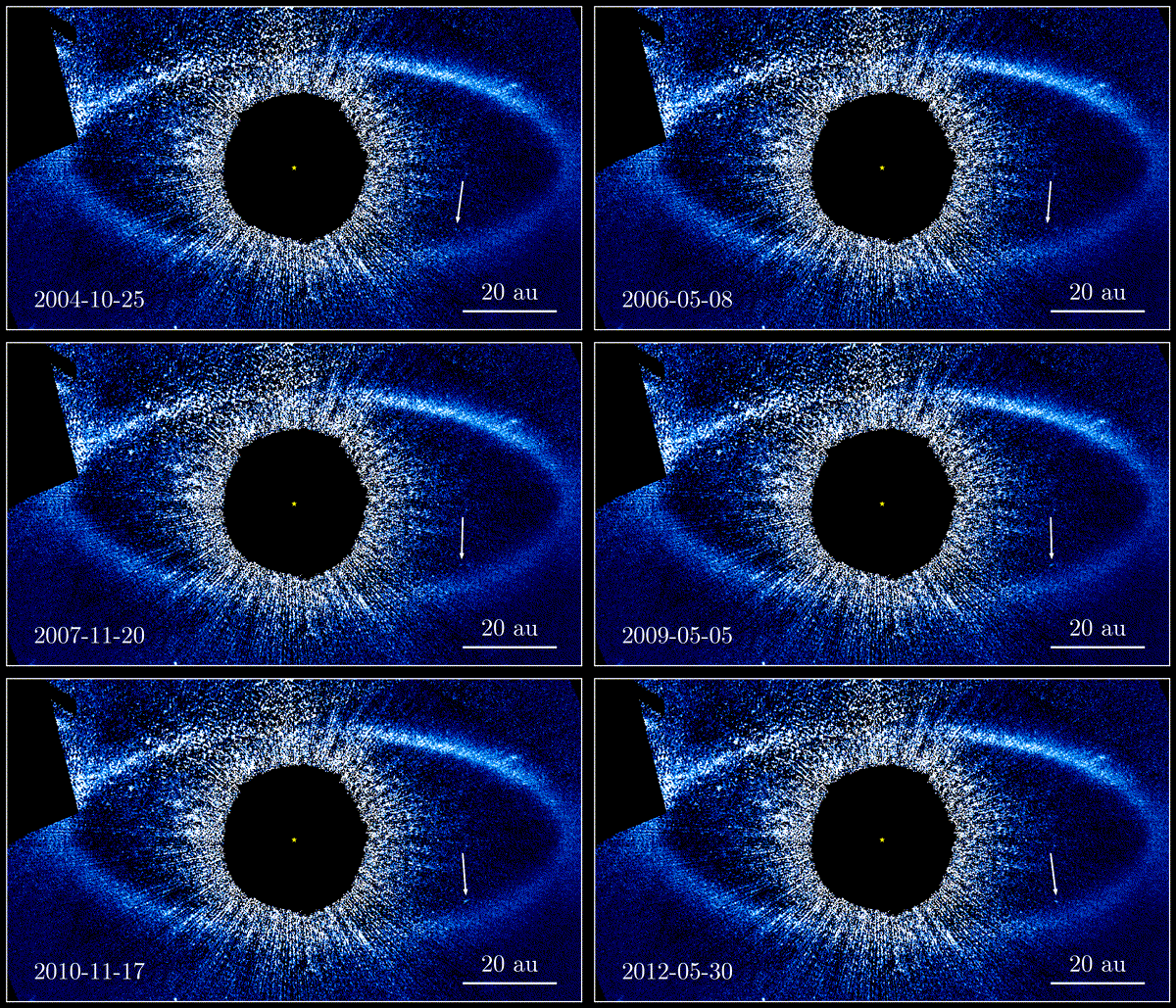
Fomalhaut’s planetary system shows a vast comet belt encircling the star and the motion of Fomalhaut b from left to right (arrow). This animation was made by Dr. Jason Wang (Caltech) using several years of my Hubble Space Telescope observations of Fomalhaut.