|
Exosolar Planets |
|
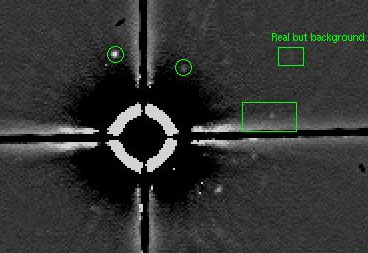
With every debris disk image that I obtain I conduct a search for a co-moving object that may be a luminous exosolar planet. Among the stars that I have conducted such searches are Beta Pictoris, Epsilon Eridani, Fomalhaut and Vega using sensitive, multi-epoch optical and near-infrared data. Like many other researchers who have carried out such campaigns, the faint sources that I have detected in direct imaging are either background objects or instrumental artifacts. Below is a coronagraphic optical image of Epsilon Eridani. The circled objects are confirmed as background stars. The box in the upper right shows a faint source detected in multiple data sets from multiple instruments that is confirmed as real, but NOT co-moving with Eps Eri, and hence a background object. The box below it marks a point source that appears to be co-moving with Epsilon Eridani year after year, but only when observed with a certain telescope. This means that it is a persistent instrumental artifact, and illustrates the difficulty in validating a planet detection.
Fortunately, using the Hubble Space Telescope to target the nearby bright star Fomalhaut, we discovered the common proper motion companion called Fomalhaut b. This is likely a dwarf planet or planet under a Jupiter mass that is seen in reflected light because of a circumplanetary satellite system. This early success in searching for planets will likely be followed by at least 20 new exoplanet discoveries through direct imaging using the Gemini Planet Imager, or GPI. Our 600 star survey will begin in early 2014 and last about three years.
|