home astro/eps 12 bio projects talks photos weather code links
 

DR MICHAEL H WONG
ASSISTANT RESEARCHER

UNIVERSITY OF CALIFORNIA
ASTRONOMY DEPARTMENT
BERKELEY CA 94720-3411

510/642-0388 (voice)
510/642-3411 (fax)

SM4 launch a success.
POSTED: Mon May 11 12:37 PDT 2009

The mood was a mixture of triumph and relief in the auditorium here at the Space Telescope Science Institute, as Atlantis successfully lifted off on its mission to service Hubble.

But what was that piece of debris spiraling off the starboard side of the orbiter, about 20-40 sec after the solid rocket boosters detached? I saw it in two separate NASA-TV camera views. One was live, and a second view showed the debris during the replays right after takeoff.

The good news is, the debris is too small to be the Wide Field Camera 3. I'm here as a Visiting Scientist at STScI working with the WFC3 team, and we'll all be keeping our fingers crossed over the next couple days, as the astronauts install WFC3 and while we await the results of the first instrument tests.

Imaging Jupiter with a wide-field AO correction.
POSTED: Fri Oct 24 11:11:26 PDT 2008


False color infrared image of Jupiter's hazes. Red/green/blue channels correspond to actual wavelengths of 2.02, 2.14, and 2.16 μm. Data acquired 16-17 Aug 2008. Higher-resolution version available on the ESO resource page.


Movie showing almost two hours of 2.02-μm Jupiter observations. Higher-resolution version available on the ESO resource page.

I participated in a very successful technology demonstration, imaging Jupiter using Multi-Conjugate Adaptive Optics (MCAO), a technique that corrects for atmospheric blurring over a wide area of the sky by using multiple AO guide stars. Unfortunately the MCAO instrument has completed its demonstration run and is not planned to return to the telescope, although feedback from the public might change their minds. If you want the MCAO instrument back on the telescope, write to Enrico Marchetti (his email is on the instrument page) supporting its return.

Press releases were issued simultaneously by UC Berkeley and the European Southern Observatory, and the story was picked up by numerous sources including National Geographic, ScienceDaily, msnbc, and SPACE.com. I presented early science results in a poster at the DPS meeting last week in Ithaca NY.

California's Proposition 8: BAD BAD BAD.
POSTED: Fri, 24 Oct 2008 09:32

Non-Californians can skip this. But 11 days from now, Californians will have a chance to make history by rejecting this proposition.

In recent years, a number of state referenda have been passed by voters in the US that increase discrimination by narrowing the definition of marriage. History shows that these setbacks will be temporary. Real progress is characterized by an expansion of equality and civil rights. Slavery, women's sufferage, and interracial marriages are examples of issues that we've progressed through, and none of those discriminatory practices will be coming back.

Californians can take a stand against discrimination by voting no on Proposition 8. If Proposition 8 can be defeated, it will mark the first time that statewide voters have taken a step forward (against discrimination) on the issue of same-sex marriage. This is an issue that affects at least two families in the Astronomy Department, so this post is not completely off-topic.

The Group.
POSTED: Wed Sep 17 13:26 PDT 2008

I recently made cartoon versions of my closest planetary science collaborators at Berkeley using the Face Your Manga portrait generator:

Name: Imke de Pater

Favorite solar system object: Jupiter, but likes everything in the outer solar system

Name: Phil Marcus

Favorite solar system object: Anything with rotating fluids

Name: Franck Marchis

Favorite solar system object: Little ones

Name: Mike Wong

Favorite solar system object: Jupiter

Name: Máté Ádámkovics

Favorite solar system object: Titan

Name: Xylar Asay-Davis

Favorite solar system object: Jupiter, but favoring Earth lately

Mini-colloquium.
POSTED: 2008-09-11, 12:01AM PDT

On August 28, we had a special Astronomy Colloquium where everyone who wanted to could show one slide for 60 seconds while they discussed their research. That format is great for an astroblog post, so here's my slide and script:

I am an Astronomy Assistant Researcher, and one of my main projects is this study of Jovian anticyclones. With Astronomy Professor Imke de Pater and amateur observer Chris Go in the Philippines, we have collected high-resolution images of Jupiter's anticyclones over the past three years. With M.E. Professor Phil Marcus and new astronomy postdoc Xylar Asay-Davis, we've retrieved high-quality velocity fields revealing the circulation of these vortices, which relates to Jupiter's otherwise unobservable atmospheric structure and deep water abundance. The color change of Oval BA in 2006 is confined to an outer ring, consistent with our vortex circulation model and Phil Marcus' prediction of climate change on Jupiter.

Three southern red ovals.
POSTED: Thu May 22 22:57 PDT 2008


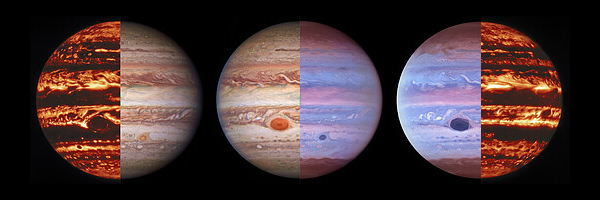
False color "bee-vision" green/blue/UV image of Jupiter, 10 May 2008. HST WFPC2.

Jupiter's red spots, like some flowers, absorb in the ultraviolet. Bees, and the Hubble Space Telescope's WFPC2, can see ultraviolet coloring like this. I put together this bee-vision image, because "as any nature film crew knows, we can gain an insight to the bee colour world by converting the red, green, and blue channels of a video camera into UV, blue, and green channels" (according to this University of Bristol page, which also says that birds perceive a four-plane color space instead of the three-plane RGB world that we see).

I feel a little tacky doing this, but hey, Details says self-promotion is key. So here's a list of places our Jupiter images got picked up by. But this is not unusual for Berkeley. Marayam, who works down the hall from me, was recently interviewed on All Things Considered for capturing a supernova from the beginning.

ORIGINAL SOURCES -- STScI (their WFPC2 snapped these shots) -- Imke de Pater (the boss) -- Chris Go (helped us figure out where these things would be) -- Keck Observatory (near-simultaneous infrared images) -- UC Berkeley (Go Bears!)

NEWS FEEDS -- Astronomy Picture of the Day (the public media fully accept the possiblity of climate variability on Jupiter) -- New Scientist (perhaps the most interesting story, includes new velocity measurements by the New Horizons team) -- Reuters (gives props to the Asians on the team, but hard to tell which spot they are talking about sometimes) -- cnet -- msnbc (I like it, they call the newest red spot "baby") -- Science Daily (the first story to liken the spawning of new spots to a disease outbreak) -- io9 (never heard of this site before, but the user comments on the Jupiter post are hilarious) -- National Geographic (they wanted to know how big the new spot is: about 4800 km, the size of the USA and China side-by-side)

Playing with food.
POSTED: Tue May 13 17:06 PDT 2008

FITS files are the "bread and butter" of astronomers: an image and metadata file format that's used by all observatories I've ever worked with, on the ground or in space. I came across this cool Photoshop plugin "FITS Liberator," developed by the European Southern Observatory, that lets you play with astronomical images in Photoshop.

Unfortunately this nifty utility doesn't have the ability to write back out into FITS format. That's what I was originally searching for: the ability to edit pixel masks in Photoshop, and then import them back into scientific analysis codes. Maybe someday. Currently we're editing pixel masks with specialized IDL code (written by student researcher Patrick Lii) that is great for processing batches of HST/WFPC2 data.

Academic kickback scheme.
POSTED: Tue Feb 26 23:12 PST 2008


I just discovered that I am part of an academic kickback scheme. However, I just want to say that I think it is totally ethical, because it demonstrates the cooperative nature of scientific research. Here's how it works.

I downloaded Mishchenko et al.'s T-matrix scattering code. It was very useful in some modeling of particles in Jupiter's ring (Wong et al. 2006). The scattering code is obviously the result of years of very competent work. Of course I referenced Mishchenko and Travis (1998), as any responsible scientist would. But in the code distribution, there was also a message that Mishchenko would appreciate hearing directly from anyone who used his code. So I guess I must have followed through and emailed him, because I just saw that our paper was referenced by Mishchenko et al. (2007), which is basically a list of everyone who has used his code.

So the kickback cycle is that I reference Mishchenko, he gets a citation count (BONUS!). He keeps track of all the people using his code, and puts out a publication (BONUS!) demonstrating the relevance of his years of work (BONUS!). The citation from his publication (BONUS!) then rewards me for acknowledging the utility of his T-matrix solver.

It's like bloggers and linkbacks, or gratuitous testimonials/wall posts on Web 2.0. Thanks, Mishchenko !!

Eclipse 2008A.
POSTED: Thu Feb 21 20:46 PST 2008

A bunch of little kids and random community members showed up last night to view the total lunar eclipse with the San Francisco Amateur Astronomers at the Randall Museum. We were plagued by clouds most of the night, but I snapped this "digiscope" image through one of the telescopes that were set up.

Aw shucks, no impact.
POSTED: Wed Jan 9 19:23 PST 2008

Further observations of 2007 WD5 led to a reduced impact probability of around 1 in 10,000. This development isn't surprising, given the previous large uncertainty region from 2007 data, but now I have an unexplained desire to blow something up.

Asteroid collision with Mars?
POSTED: Wed Jan 2 13:23 PST 2008

Chance of impact: 1 in 350 (estimated in early December), 1 in 77 (21 December), 1 in 26 (28 December). As more and more data are being used to estimate the orbit of asteroid 2007 WD5, the chances of collision with Mars keep improving.

The graphic above uses white dots to show the possible locations of 2007 WD5 when it crosses Mars' orbit. The large spread in the positions of the white dots shows that there is much room for improvement in the orbital estimate, but even a near miss could be exciting. Although I would rather see the formation and evolution of a crater on Mars (Do the ejecta form a lobate pattern? Is methane released from the heated post-impact soil?), a near-miss with orbital deflection and/or SL9-style tidal disruption of the asteroid would be cool too.

My fan mail.
POSTED: Mon Nov 19 18:07:39 PST 2007

Earlier this month, on a day when I was particularly frustrated with proposal-writing, I was cheered to find a delightfully unusual letter in my inbox. A parent of one of my summer students wrote in to tell me that I had gotten his daughter excited about astrobiology, and thanked me for my influence on her life.

As I told Doug, educators are always delighted to have students who are genuinely interested in the material. Catherine was one of those advanced high school students who enrolled in UC Berkeley Summer Sessions. She stayed after class several times to chat about things that we covered in lecture, and conversations like these give teachers the feedback they need to build a good class. So I didn't expect any more reward or recognition, but getting parent fan-mail takes this to another level. Here are some gratuitous quotes about how awesome I am (Doug said it was OK to post these):

I wanted to take the time to write you and thank you for the time you spent with my daughter outside of class... you may have changed her life forever.

She has found her life's calling as an "astro biologist." I remember she called me the day she met with you and I had never heard her so fired up before. She had taken an Astronomy class at the local community college, but I never heard her excited like this before.

I wish you continued success in your most fascinating career and hope you will never lose the ability to reach out to students in the way you did with my Catherine.

-- Doug Traub

Job announcement.
POSTED: Tue Sep 18 14:48 PDT 2007

If anyone's interested, NASA is looking for an astronaut.

Equatorial clouds and haze before, during, and after Jupiter's global upheaval.
POSTED: Thu Sep 6 15:11 PDT 2007

I am about to hit the "submit" button for a Fall AGU abstract of this title. They have a new submission form, which allows you to include one URL per abstract. So my URL points here, where you can see quite clearly that the equatorial cloud cover has changed significantly between 2000 and 2007, when Jupiter's global upheaval was in full swing.

If the equatorial cloud clearing is sustained for a few years, it may enable us to figure out exactly how the upper tropospheric haze is supplied. Is the haze composed of fine cloud particles wafted up from below? Or is it composed of a photochemical "smog" that is continually produced and continually settling out of the atmosphere?

This week's naked eye events: Aurigid shower, lunar eclipse.
POSTED: Mon Aug 27 10:02 PDT 2007

The globe above shows the view of the Earth from the perspective of approaching Aurigid meteors at the time of the shower peak, which will occur late Friday night (early Saturday morning on September 1).

Annual meteor showers (like the Perseids) are typically caused when the Earth passes through the trail of dust debris left by a short-period comet. The Aurigid shower, which is predicted to peak at 4:33 PDT, is a different story. These meteors are debris from long-period comet Kiess, which has perhaps only ever made two close approaches to the Sun. The dust may have a more pristine composition than short-period comet dust, which may explain the green and blue colors associated with one report of Aurigid activity in 1994.

In any case, the Aurigid shower is not predicted to occur again within our lifetimes, so this is a unique opportunity to witness this particular shower. Although it's inconvenient to be up at 4-5am for most people, the reward will be a relatively short burst of meteor activity, probably with several bright meteors. Click on the globe above for more info. Unfortunately I will miss this event because I'll be in Michigan, where it will already be daylight when the shower takes place (see above).

There is also a total lunar eclipse tonight !! Below is a diagram showing the eclipse timing, as well as a description from one of the professors in my department:

Though the time of night isn't ideal (conflicts with sleep, for most of you), there is a great opportunity to see a total lunar eclipse this Monday night (Tuesday morning, Aug. 28) -- that's tomorrow night (or tonight, depending on when you read this)!

The partial eclipse begins around 1:51 am PDT on Aug. 28 (Tues. morning). Totality will be reached at 2:52 am PDT, and it will end at 4:22 am. The second partial phase will end at 5:23 am PDT, just before dawn on Tuesday, August 28.

Lunar eclipses are totally safe to watch, and no optical aid is needed. Telescopes and binoculars can provide even better views, but are not necessary. Just find a spot with clear skies and a relatively unobstructed horizon (especially to the west), and enjoy the view! If it's foggy in Berkeley/Oakland, try heading inland (Walnut Creek, Livermore, etc.).

I hope you have a chance to see the eclipse, if only briefly.

-- Alex Filippenko

Perseid viewing party.
POSTED: Fri Aug 17 11:01 PDT 2007

The summer 2007 session of Astro/EPS C12 is over... What am I going to do now, research? The class was intense but students said they learned a lot. Here is a pic from our Perseid-viewing party. About 15 of us reclined in a parking lot where it was dark enough to see the Milky Way, and we saw quite a few spectacular meteors.

Depleted uranium.
POSTED: Wed Jul 11 23:02 PDT 2007

Last weekend I went to a San Francisco Mime Troupe performance in Dolores Park. They are doing a pretty amusing production commenting on the Iraq war, with a major plot thread relating to the increase in Iraqi cancer rates as a result of US use of depleted uranium (DU) munitions. Apparently this is true. I searched the web and found a light-hearted 2003 Guardian article about DU, an old collection of BBC articles about DU, an International Action Center page about DU, with a link to the documentary Poison DUst, a FAQ at the International Coalition to Ban Uranium Weapons, numerous Christian media outlets such as the Christian Science Monitor investigating DU, a military site defending the safety of DU, and an interview with a German doctor who analyzed DU munitions.

And I had no idea about any of this.

Here are the depleted uranium facts I learned:

  • Depleted uranium is called that because the uranium-235 is removed for use in fission reactors, leaving a bunch of uranium-238, which is less radioactive. Natural uranium is mostly uranium-238 anyways, so depleted uranium is only 40% less radioactive than natural uranium.
  • Uranium is a very dense metal, so uranium artillery rounds are very effective at penetrating armor. This is why depleted uranium is used. US vehicles are also plated with DU armor because of its high density.
  • DU munitions were used a lot in conflicts in Kosovo, Bosnia, Kuwait, and Iraq.
  • DU has the property of being "pyphoric," which means it gets so hot on impact it burns up, releasing fine particles which can be dispersed by wind and enter the body. This is what makes it so deadly, since the alpha particles given off by DU decay are stopped by the skin.
  • In one area, where DU weapons were used in the Kuwait conflict, cancer rates increased by an order of magnitude: "in 1989 there were 11 per 100,000 births; in 2001 there were 116 per 100,000 births," reports the Seattle Post Intelligencer.
I like America. Very much. But I don't like my tax dollars being spent on the commission of what most people consider to be war crimes.

Ghost-free remote observing.
POSTED: Tue Jun 19 04:02 PDT 2007

That's me using the newly-created remote observing room in the basement of the Berkeley Astronomy Department. In the photo, taken with the basement iMac's built-in iSight, you can only see four of the seven displays I am using. Yes, I do need that many pixels.

I am here to collect Trojan asteroid lightcurve data, as part of an effort to physically characterize these relics of outer planet formation.

Remote observing is a trend being followed by pretty much every observatory I've used. It conserves resources because observers don't need to make expensive trips to distant observatories, but I still have conflicting feelings about it in general. I think all of us observers have had some really enjoyable experiences at the observatories, and it will be sad to have fewer of those experiences. For example...

Ghost story: I had always heard that the Ghost of James Lick haunts the main hall at Lick Observatory. After all, the man's corpse is buried under the 36-inch refractor. Last time I was at the 40-inch Nickel telescope (the same one I'm controlling remotely tonight), I went down the hall to take out my contacts in the middle of the night. On the way back to the control room, I heard noises ahead. I walked quickly up to the end of the hall to see what the noise was, because I thought I was alone in the building. I was--of course--completely unafraid, yet I had a tingly feeling all over my skin. At the end of the hall, I saw the inside of the brightly illuminated elevator, and the door quickly closed before I could see whether there was anyone inside. I pressed the elevator call button, and it didn't respond at all, yet it didn't go upstairs and open either. Strange... Just in case it WAS a ghost, I turned down my thumpin' house music in the control room. That seemed to work, since I witnessed no more unexplained mechanical occurrences.

All your atmosphere are belong to us.
POSTED: Tue Nov 14 00:26 PST 2006

This post does not represent the opinions of the University of California, my boss, your lawyer, or the oil cartels. The opinions represented here belong exactly to me. This astroblog is getting increasingly opinionated, so if you think I'm being stupid, please contact me and tell me so.

I have to admit a terrible secret. I have read The State of Fear (Crichton, 2004). Voluntarily. Even though I am an atmospheric scientist. And I enjoyed it. I don't want to give too much away, but basically I could not put the book down because I am partial to cute octupi. Also it was fascinating, in the same way Fox News would be fascinating if you had to pay $6.95 for it. Daniel had read the book, probably as an act of last minute international flight desperation, and then handed it on to me, so in my defense, I hadn't directly paid for it. Even so it was fascinating, just as fascinating as--for example--a story about claims in modern Japanese textbooks that no atrocities had been committed in China.

State of Fear is a pretty alert portrayal of how the media thrive on perpetuating fear among the ignorant masses. The sinister aspect was that in the book, media-generated fear was a tool used to generate funding for corrupt environmental charities. In real life, media-generated fear is used to increase ratings and to elect corrupt candidates from fear-mongering political parties who then pass laws that allow petroleum corporations to plunder the environment from local to global scales, thereby increasing corporate profits.

Then somehow this year I didn't notice that Crichton won a journalism award for the book in February, from the AAPG. All you need to know about that acronym is that P stands for Petroleum. Totally tangential fact: On the AAPG website, the only advertising banners sold went to Shell and ConocoPhillips.

I also didn't notice when in September Eos published a declaration that this award was inappropriate, presented by the Council of the AMQUA, and I still wasn't paying attention when Eos published rebuttals to the AMQUA Statement of Impropriety (same Eos excerpt above, mirrored here just in case the site is members only).

But I was flipping through the Halloween paper edition of Eos, when I saw a highlight adverstising a moderated discussion in the online version, on the topic of Eos's publication of comments on the award to Michael Crichton. So here is my comprehensive but completely biased paraphrase of the whole discussion:

The Declaration of Impropriety:

AMQUA: that award was bogus
AMQUA: the book is not journalism, and he blurred the line between fiction writer and scientific expert
AMQUA: the foo' went up in front of congress as a climate change expert witness !!
AMQUA: the AAPG is the only scientific society that denies the human-induced effects on global warming
AMQUA: the AAPG should just admit they're workin for the oil corporations and their politicians

The Rebuttals:

singer: hey you just said the karl et al. (2006) u.s. climate change science program report proved global warming
singer: but actually it only says that in the summary
singer: one of the figures actually contradicts this and proves there's no global warming
corbett: yo
corbett: AGU and AMQUA should mind their own damn business
corbett: AGU is the one fabricating science, not AAPG
corbett: environmentalists lie about global warming to advance their liberal agenda
corbett: broeker [sic] and stocker 2006 are the experts, and they proved that people didn't cause global warming

Online:

u-dub: uh...
u-dub: guess what corbett, in broecker and stocker 2006 they were talking about 6000BC to 1850AD
u-dub: like, before fossil fuel burning
u-dub: they weren't talking about after 1850
u-dub: don't use wally broecker's article to justify something they didn't say and wouldn't agree with
u-dub: that's RUDE !!
corbett: did you read the last sentence? it goes:
corbett: "the CO2 rise during the last 8000 years was 'natural' and not 'anthropogenic'"
corbett: you don't speak for walter broeker [sic] and tom stockman [sic]
corbett: so we'll chalk you up as another academic pseudo-scientist leading with a weak political argument and lazy and confused at best and dishonest at worst approach to citing the literature [note-- this one is verbatim]
sierra club: speaking of reading
sierra club: the article talks about how CO2 went up to 280 ppm from 240 ppm in 6000BC
sierra club: but since everyone knows that since 1850 it went up a lot more to 380...
sierra club: it's pretty clear they were only talking about pre-1850
rob quayle (retired): these climate change skeptics are not real scientists
singer: hey it's me again
singer: did you read my letter?
meier @NSIDC: corbett you're a scoundrel
meier @NSIDC: it clearly says they're talking about pre-1850
meier @NSIDC: IN THE FIRST SENTENCE
meier @NSIDC: citing this article in a discussion of industrial climate change is misleading
meier @NSIDC: corbett needs to join crichton in a class on how to read and cite scientific journal articles

created with giardiacorp.com/404002.html.

Is it just me or did that last guy from NSIDC practically admit to reading State of Fear? Caught ya... But I'm sure he's awesome, because the NSIDC makes these awesome 6" x 8" yearly planners that they give out for free at Fall AGU meetings. I can't live without their planners and their beautiful monthly satellite images of Alaskan and Antarctic ice.

Saturn's south pole.
POSTED: Thu Nov 9 13:28:04 PST 2006

NASA released some spectacular images of Saturn's south pole, which were taken by Cassini on October 11th of this year.

The first image shows outer rings of clouds surrounding the pole, as they cast shadows onto lower cloud decks. The press release describes these as eye-wall clouds, like those in terrestrial hurricanes. But the science writers are now being careful to emphasize fundamental differences between the system on Saturn and the very different conditions applying to terrestrial hurricanes.

The second image shows the south pole at six different wavelengths. I'm not involved in Cassini right now, but I love these images because they are great proof (in case we needed any) that Saturn's atmosphere is not boring.

My take on the definition of "planet."
POSTED: Sat Aug 26 15:06:04 CDT 2006

I agree with the new definition of planet (within our Solar System) in IAU's resolution 5A:
(1) A planet is a celestial body that (a) is in orbit around the Sun, (b) has sufficient mass for its self-gravity to overcome rigid body forces so that it assumes a hydrostatic equilibrium (nearly round) shape, and (c) has cleared the neighbourhood around its orbit.

There is a bit of ambiguty in condition (c), because it's not clear what "cleared the neighborhood" means. The Earth hasn't "cleared" the Moon, Jupiter hasn't "cleared" the Trojan asteroids, etc. But the Earth and Jupiter are planets.

I interpret "cleared" in the context of Solar System history. The current planets are the survivors of an intense accretionary battle. I think condition (c) means that a planet has cleared its neighborhood of anything that could possibly challenge it in an accretionary duel. So WHAT if Jupiter hasn't cleared the Trojans? Jupiter SWALLOWED SL/9; the Trojans wouldn't stand a chance. Neptune vs. Pluto? Neptune. Ceres may be large enough to be round, but there are plenty of asteroids that could probably disrupt it in a collision. This distinction is important because both Jupiter and Ceres share the "neighborhood around their orbits" with numerous small Solar System bodies, yet of these two only Jupiter is considered to have "cleared the neighborhood."

But there are others who disagree with resolution 5A. A petition is being circulated among scientists, stating:

Petition Protesting the IAU Planet Definition
We, as planetary scientists and astronomers, do not agree with the IAU's definition of a planet, nor will we use it. A better definition is needed.

I am not posting the link to this petition because (a) I don't agree with it and I don't want it to get signed and (b) they asked for it not to be a public petition.

The main objection to resolution 5A, according to the email that is advertising the petition, is that it "uses dynamics (location) rather than intrinsic properties to decide if an object is or is not a planet. This result is counter to other classification schemes in astronomy (e.g., stars, galaxies, nebulae, even asteroids) in which dynamical context does not play a controlling role." Also, the petition's truly distinguished authors claim, demoting Pluto is problematic.

Pluto's status is a problem that people can deal with. Franck Marchis told me that asteroids initally were considered planets as well, yet people managed to survive the transition of their status to minor planets. And New Horizons has already been launched to Pluto, so this resolution shouldn't change anyone's funding status.

The petition's claim--that resolution 5A's condition (c) is not based on "intrinsic properties"--does not take into account the difference between planets and the other astrophysical objects cited in the email. Planets are ONLY formed around stars, and planets always result from multi-stage, complex formation processes that include accretion and dynamics. You cannot have a planet without dynamical evolution. So I don't have a problem with resolution 5A defining planets based on having completed all the stages of the accretional process. The final stage, in which one of the largest members of a planetesimal population manages to become a planet by accreting or expelling other planetesimals, is essentially complete when there are no planetesimals left that could accrete or eject the planet. Nothing in the asteroid belt ever reached this stage, and nothing known in the Kuiper belt, including Pluto, ever reached this stage.

Still... Red Spot Jr.
POSTED: Sun Jul 30 2006

Also available: supersize (986x986) near-IR image, supersize (986x986) thermal-IR image.

These are images we acquired with adaptive optics at Keck last week. A press release is posted on the Keck website. The false-color near infrared image (the one showing Jupiter's full disk) is composed of frames taken in three different filters. The spot on the upper right of Jupiter is Io, which we used as the AO guide star. It looks like a multicolored dot because it was moving closer to Jupiter throughout the observations. The image didn't look that great with the filter images loaded into the RGB channels, so I loaded them into the magenta-chartreuse-blue channels instead.

One of my main goals when I came to Berkeley as a postdoc was to work on pretty pictures. I believe I've got that one covered now. I mean, analyzing streams of spacecraft data is fun too, but it's not the best blogging material.


Red Spot Jr.
POSTED: Thu 04 May 2006

Wow so this is exciting. We have a press release about this new red spot on Jupiter, at the HST front page and the Berkeley NewsCenter. Imke was really nice because she forced the HST people to put my name on the image credit. The press release front page shows a hi-res image from Amy Simon-Miller's team; an additional hi-res image from our team (deprojected by Sean Lockwood) is on a secondary page.

So there was a bit of controversy when we were putting together the press release. The STScI people wanted the wide field image to resemble the hi-res image, even though the hi-res image is practically true color (top left) and the wide field image is false color (top right). In the wide field image, blue is actually visible (502 nm, or cyan) and yellow is actually infrared (strong methane band at 892 nm). The original image I put together for the wide field (below) used jarringly unrealistic colors, so that it would be clear that the "red" spot looked red in that image because of its altitude, rather than its chromophores. I used green to represent visible and pink to represent infrared.

It's a lot more ominous, a lot more ... electroclash:


Red Spot Jr.
POSTED: Sat Apr 22 2006

Most of my time recently has been spent frantically preparing for HST observations of Jupiter's new red spot. "Red Spot Jr." is not as great as the Great Red Spot, but as you can see in the image taken below by Chris Go, it is as red. This oval was formerly white, but sometime in February 2006, it changed color. Chris Go discovered this color change at his home observatory, and it was seen by other amateur astronomers in February as well.

Unfortunately, we can't yet explain why the GRS or RSJ are red. In fact, planetary scientists can't even agree on the composition of the visible cloud layer on Jupiter!


Astroblog.
POSTED: Thu Apr 20 2006

Yay, it's a new redesign for this site. What you are looking at now is an astronomy blog. This is kindof a response to a statement in my advisor's latest CfAO annual report, in which she stated,
We all keep an up-to-date website featuring our latest research. (http://astron.berkeley.edu/~imke, http://astron.berkeley.edu/~fmarchis, http://astron.berkeley.edu/~madamkov)
Of course when I read that I was mortified. Clearly I'm not fulfilling my EPO job requirements, since I had no website featuring my latest research.

As of now, I am no longer inadequate, webpage-wise. Check out my latest research.