Eugene Chiang
Postal: Astronomy Department, 501 Campbell Hall #3411, Berkeley CA 94720-3411
Office: 605C
Phone: (510) 701-5996
Email: echiang {at} astro.berkeley.edu
Personal
Theoretical astrophysics, with emphasis on understanding the origin and evolution of
planetary systems.
Interested students should talk to me or the students I work with.
Research areas include extrasolar planets, protoplanetary disks, debris disks including the Kuiper belt, planet formation, gravitational dynamics, hydrodynamics.
Spring 07/08/19/20/21: For graduate students and prepared undergraduates. Hydrodynamics and magneto-hydrodynamics, with emphasis on developing intuition, order-of-magnitude problem-solving skills, and the ability to interpret the astrophysical literature. Applications include stellar winds, accretion disks, and galactic sub-structure.
Spring 06/09/23, Fall 14/21: For undergraduate and graduate students. Learn the art of estimating everyday quantities to within a factor of 10. Material properties, fluid mechanics, biophysics, waves and sound, pop culture (e.g., Lady Gaga and Proposition 13).
Spring 03/04/05/22, Fall 19/20: Astrophysics of planets, both within the solar system and outside it, geared for upper division physical science majors and graduate students. Interiors, atmospheres, gravitational dynamics, planet formation.
Spring 13/14/15/16/17/18: For undergraduates, geared toward double majors in physics and astronomy. Continues the survey of modern astrophysics begun in 7A, applying elementary physics to the understanding of astronomical objects. Tides, accretion disks, black holes, gravitational lensing, superluminal motion, galaxies, cosmology.
Fall 09/10/11/12: For undergraduates, geared toward double majors in physics and astronomy. An introduction to modern astrophysics, applying elementary physics to the understanding of astronomical objects. Orbital motion; interaction of radiation with matter; stellar evolution; compact objects. Companion course to Astro 7B.
Fall 03/04/05/06/10: Fundamental principles underlying why we see what we see in astronomy, geared towards graduate students.
Fall 02/11: Graduate seminar on the gravitational
dynamics of planetary bodies. For a full course description, including
readings and problem sets, click on the link.
Fall 07: Wiki-based graduate reading seminar on galaxies. Orbit theory, spiral structure, bars, numerical
algorithms (linear programming and tree codes), relaxation, black hole
dynamics, and formation.
Fall 05: Graduate reading seminar on extra-solar super-Earths.
Fall 03: Graduate reading seminar on seminar papers in earth science, co-taught with Raymond Jeanloz.
Born in
New York 1973. Our family's rescue dog Mr. Brown is an A.K.C.-certified Canine Good Citizen with a unique genealogy.
The Berkeley Astronomy Department has a longstanding tradition of putting together an annual play every December to celebrate the holiday season. What makes our tradition unusual is that the faculty are held responsible for putting it together every three years (responsibility rotates between the faculty, students, and postdocs in a three-year cycle). I have been involved in writing and acting, and in several years directing, since 2003. I co-wrote and acted in the 2006 play. In 2009, I wrote a scene in which the arXiv server "cron" achieved sentience ("cron" became a recurring character in later years). I wrote, directed, cast, acted, and created the special effects for the 2003 Faculty Play, the 2012 Faculty Play, and the 2015 Faculty Play (the 2015 play was co-written with Aaron Parsons). I especially liked the video clip that I subtitled for the 2015 play.
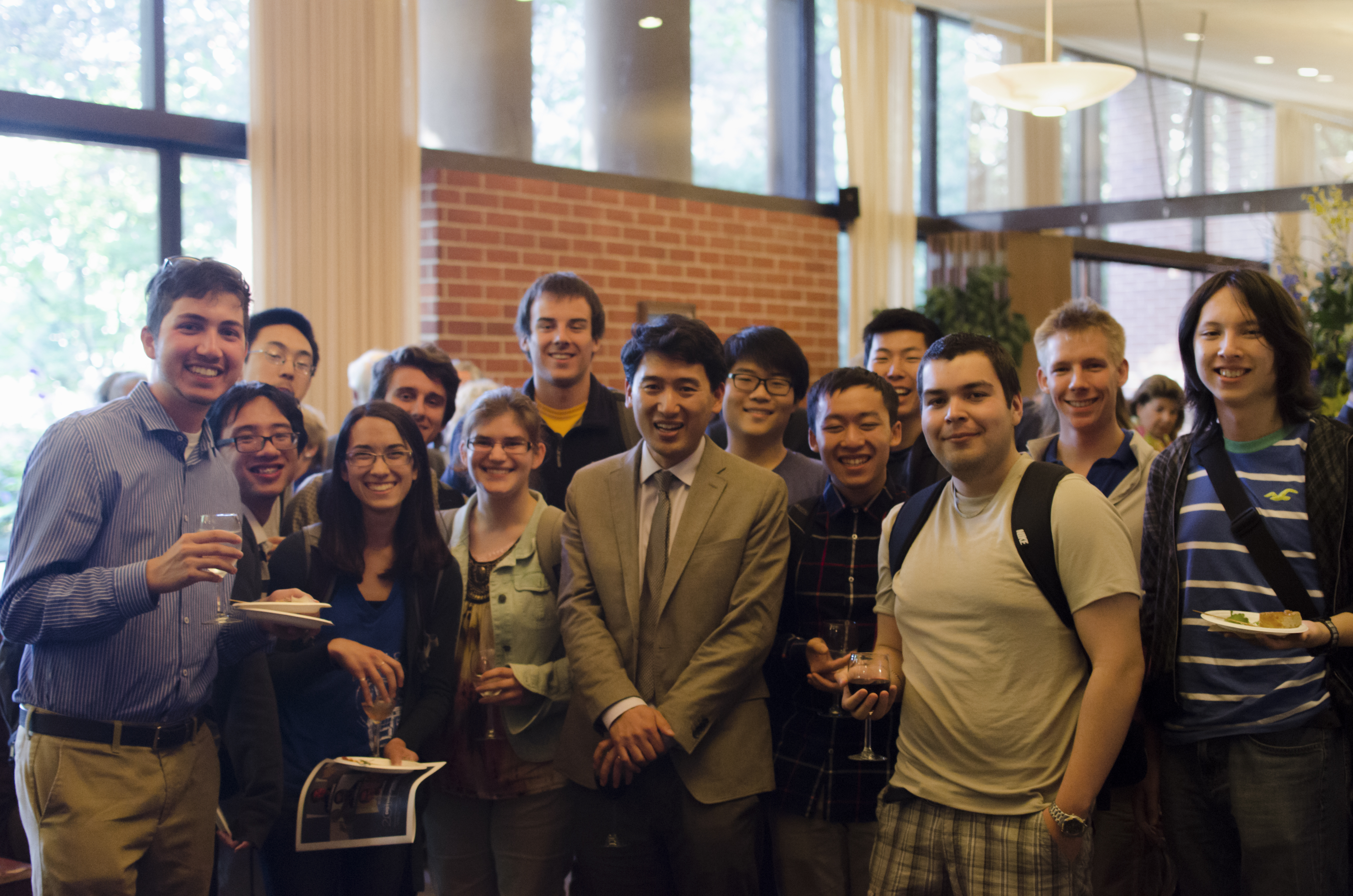
On the occasion of receiving Berkeley's Distinguished Teaching Award with the Astro 7B class of Spring 2014: