RESEARCH INTERESTS
Martin White
Recent publications
Overview
I am a theorist and phenomenologist. While I originally trained in Particle Physics, in the last few years my interest has centered around the question of the formation of galaxies and structure in the universe. How did it originate, what were the forces responsible for making it what it is today and what can it teach us about the universe? I am particularly interested in using cosmology to test General Relativity, to learn about the nature of the dark energy believed to be causing the expansion of the universe to accelerate, and in the formation and evolution of galaxies and large-scale structure.
Cosmology today is in a state similar to where particle physics was 20 years ago. The big picture is in place, but many of the fundamental questions remain unanswered. With the tremendous growth in computational and observational power, cosmology is a rapidly moving and fairly young field and can also be quite competitive.
I am a member of the Theoretical Cosmology group. My work involves both analytical and numerical components, with some simulations and data-analysis. It ranges from analytic models of structure formation to numerical simulations of dark matter and gas to analysis of observational data using sophisticated modeling for the physics and statistics. The basic framework is (general) relativistic perturbation theory and quantum field theory, plus some simple radiative transfer and fluid mechanics.
While the study of structure formation is a unifying concept, my research falls into four separate categories:
In addition to my purely theoretical work I am a member of several large experimental/observational teams. The line between theorist and observer has been increasingly blurred in cosmology, and I often straddle the divide. On many cosmology experiments theorists often play a role in identifying which measurements are most amenable to comparison with theory, producing calculations or simulations which can be used to analyze the data, invent new techniques for data analysis and use these to tease out the answers to specific questions.
The quickest way to see what I am thinking about is to look at my list of publications, some of which (plus tutorials, movies, pretty pictures etc) are online.
Questions in Physical Cosmology
Since the mid- to late-80s the study of cosmology has changed radically in both the quantity and quality of data available -- it has become a truly quantitative science and even a field of precision measurements. In fact both astrophysics and cosmology have experienced an enormous growth in experimental activity recently, due in part to advances in computing and low-noise detectors, and there is reason to believe that significant progress on the major questions in these fields will occur within the next few years.
We now have an incomplete, but highly predictive, theory which connects the structure we see in the universe today to the exotic high-energy physics of the early universe. Within this paradigm calculations can be carried out with high precision and their predictions compared to the wealth of data we are rapidly accumulating. Our models can simultaneously match the microwave background fluctuations which trace the universe 400,000yr after the big bang, the nearby distribution of galaxies, the distribution of mass revealed by gravitational lensing and the structure seen in the spectra of distant quasars. It reproduces the acceleration of the cosmic expansion rate, the baryon fraction in rich clusters and the baryon abundance fixed by the theory of Big Bang Nucleosynthesis. For the first time we have an apparently complete cosmic census of the major components of the energy density of the universe, but we know almost nothing about most of the matter and most of the energy in our list! Also, we have increasingly good reason to believe that the largest structures that we see in the universe arose from tiny fluctuations in the early universe which were amplified by inflation. But we don't have a good model of inflation which meshes with our knowledge of high energy physics.
Questions to which we don't know the answer include:
The study of
the large-scale structure of the universe
is also undergoing a tremendous growth spurt.
In the early 1980s there were less than 5,000 galaxy redshifts known.
We now have over 1,000,000 and are on our way to 30,000,000 in the next
few years.
Several new surveys have recently been
completed.
The 3D distribution of galaxies in our local universe has been mapped,
and that structure can be matched to the
early-time snapshot provided by the CMBR.
Since any model of structure formation must explain
both the tiny ripples in the Cosmic Microwave Background temperature across
the sky, and the large-scale structures we see in the universe today, the
combination of these two probes is especially powerful.
Together they enable us to probe the spectrum of fluctuations over about 4
decades in length scale and its evolution over almost the entire age of the
universe.
Large-scale structure surveys have become increasingly important as ways
to probe dark matter and dark energy, to constrain galaxy formation and
of course the formation of large-scale structure. The latest generation
of large-scale structure survey is
DESI.
Recently it has become possible to map directly the dark matter distribution
through its effect on the propagation of light through the universe.
The gravitational
deflection of light provides a mapping from the source plane to the
observed (image) plane which contains information about the distribution of
the deflecting mass.
Since the deflecting potentials are dominated by the dark matter on
cosmological scales this provides a means of mapping the large-scale
distribution of dark matter as a function of time directly, rather than
by luminous tracers. This weak lensing technique is fast becoming
an important tool in cosmology, with numerous groups having
detections of cosmic shear in galaxy surveys and of the cosmic microwave
background radiation.
While gravitational lensing provides us with an "integrated" view of
structure projected along the line-of-sight, we can also watch the growth
of large-scale structure in action. By measuring fluctuations in the
absorption of light from distant quasars (the so-called
Lyman-alpha
forest) we obtain a map of the universe when it was 10% of its current age.
By mapping galaxy clusters
(the mountains of the cosmos) we gain an insight into the process of
structure formation as it is occuring today -- a special epoch when the
universal expansion is beginning to accelerate.
With the advent of the
Planck
results cosmology has passed a turning point.
Our ability to model structure formation on large scales and at early times
has been impressively demonstrated. Over the last decade the theory of
galaxy formation, based on these initial conditions, guided by observations
and aided by elaborate numerical simulations, has also made dramatic progress.
Galaxy formation is intimately tied to gravitationally bound dark matter halos,
which provide the skeleton for the galaxy distribution. While questions
remain, the distribution of halos can be reliably simulated on a wide range
of scales. However, all existing models require prescriptions to incorporate
the complex physics of cooling, star formation and feedback into cosmological
structure formation, making ab initio calculations difficult. As
a result, many theoretical models have been created to supplement
computational approaches. These models have now turned into a significant
tool for moving from description to understanding, by isolating fundamental
ingredients necessary to reproduce a wide range of observations.
Several variants exist, with different strengths and underlying assumptions;
people developing and testing these models range from analytic theorists and
numerical modelers to those doing the hands on data analysis for current
surveys.
Structure formation is highly complex, however the observed galaxy
distribution exhibits remarkably regularity. We are now, excitingly,
in a position to extract the key physical ingredients behind this regularity
from observations and simulations.
The Cosmic Microwave Background gives a
snapshot of the universe (plus some processing) corresponding to
when the universe was about 300,000 years old.
With the expected increase in data over the next few years, these early
conditions, and a variety of cosmological parameters, will become ever
better determined.
In order to study how the structure in the universe evolves from these
small fluctuations at early times into the
large scale structure we observe in many other ways,
numerical simulations have become crucial.
This is because gravity acts non-linearly -- a large
amount of mass will attract other mass around it, increasing the amount of
mass at that position. This enhances the attraction to other nearby
mass and so on. Beyond a certain stage analytic calculation becomes
intractable. The heuristic picture is understood:
gravitational collapse takes the initial pattern of small density
fluctuations in the early universe and transforms them into regions which
are either more and more dense or more and more underdense, with overdense
regions eventually forming stars, galaxies, galaxy clusters, etc.
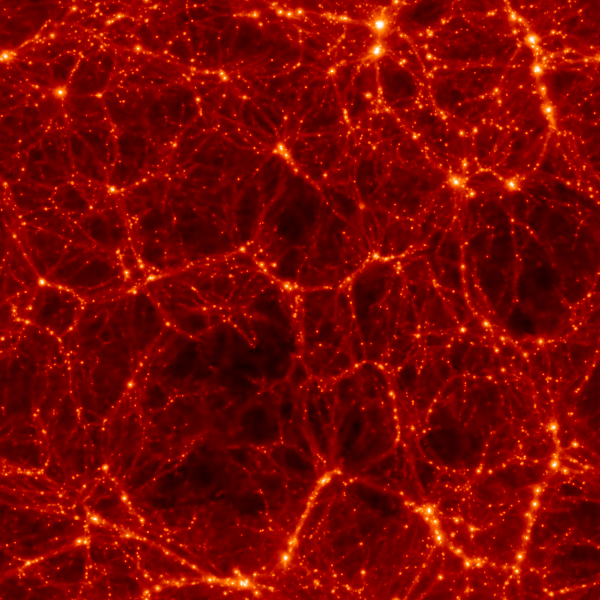
The resulting "cosmic web" has highly dense regions embedded as nodes in an
interconnected filamentary structure.
More details of this process are becoming accessible to both observational
and numerical investigation.
Due to advances in computational power, numerical simulations can now
reliably capture many properties of this evolution, providing copies of
mock universes whose statistical properties can be compared to our own
and upon which we can experiment.
These simulations can either be used to characterize features of the standard
paradigm (e.g. with
Cold Dark Matter
dominating this collapse process) or to test how changes in this paradigm
(for instance varying initial conditions, cosmological parameters or properties
of the dark matter) might affect various observations.
These simulations can have
dark matter
alone (which is collisionless and so just involves gravitational interactions),
include dark matter and other matter (and thus collisions and hydrodynamic
effects), or go even further.
Although simulations cannot yet describe all processes and scales of interest,
in certain cases the necessary physics can be included and compared with
observation.
This can be used to confront the new and exciting data with both standard
theory and its extensions.
In my work I have been using numerical simulations to study
many of these cases, including
galaxy clusters (some simulation results are
here),
weak
gravitational lensing by large scale structure or galaxy clusters, the
Lyman alpha forest,
and the
Sunyaev-
Zel'dovich effect (scattering of CMB photons off of ionized electrons).
There are transparencies from an introductory talk on numerical
simulations in cosmology
here and some movies linked from here.
Part of the reason for our optimism that we will `soon' know the answers
to many of our most basic questions comes from our recent ability to measure
fluctuations in the Cosmic Microwave Background
Radiation (CMBR).
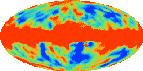
This radiation is a snapshot of the universe when it was only 300,000 years
old, long before the formation of stars and galaxies.
The minute fluctuations in the temperature of the CMBR across the sky can
tell us about the seeds of the structure which we see about us today and
also measure with unprecedented accuracy all of the
major cosmological parameters.
A review of the current state of the cosmos can be found in the web pages
of ESA's
Planck
satellite mission or the
CMB-S4 collaboration..
These CMB data have dramatically confirmed our basic theoretical picture.
For more theoretical details, see
The
Cosmic Symphony or
The Cosmic Rosetta
Stone
(which is one of several on-line documents
describing the CMB, large-scale structure and cosmology).
At a slightly higher level, the essay
Echoes of Gravity
by Douglas Scott and myself covers the basic physics of CMB anisotropies
in a few pages.
Large-Scale Structure
Galaxy formation and evolution
Numerical simulations of structure formation
The Microwave Background
